
Silicon Photonics Architecture: Quantifying Link Budgets and Optical Nonidealities

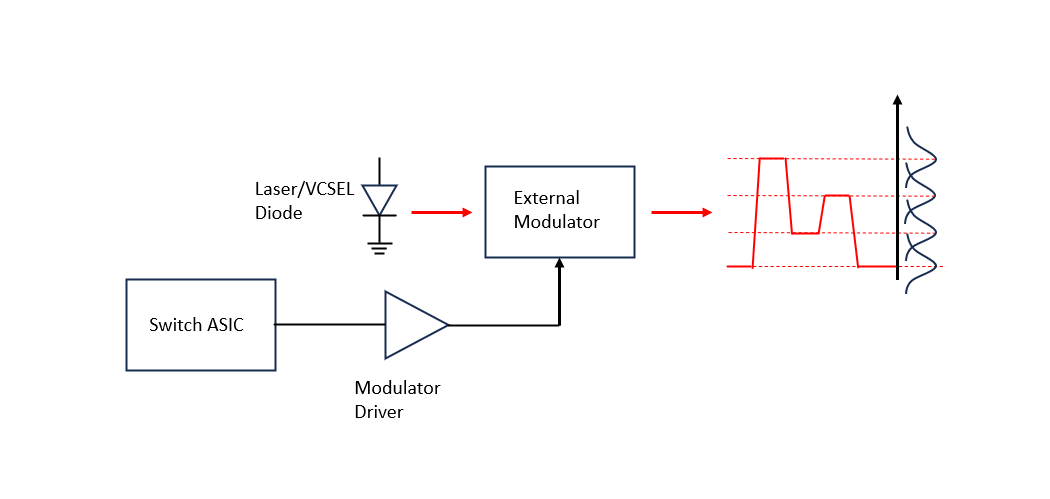
Silicon photonics is one of the hottest and fastest moving markets to address high speed data demands in co-packaged optics (CPO) in AI data centers.
In this post I’ll cover a few important high-level details of silicon photonic circuits. These include:
An Overview of the Link Budget and important considerations:
Laser Power
Connector Losses
Receiver Figures of Merit
🔒Key Figures of Merit for eye quality
🔒Validation Challenges (wafer screening and thermal stability)
Link Budget
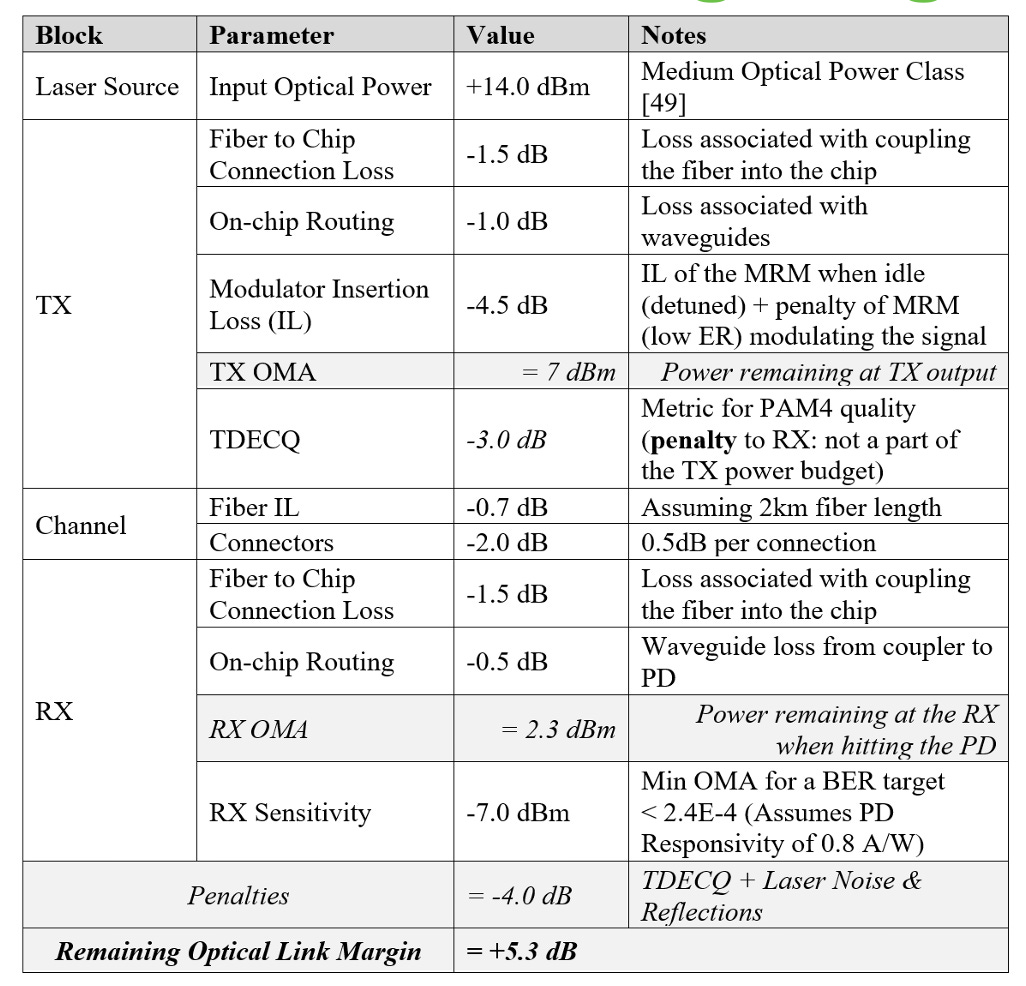
Understanding link budgeting is important to develop a system level understanding of a SiPh transceiver. Consider a typical electro-optical link with an external modulator:
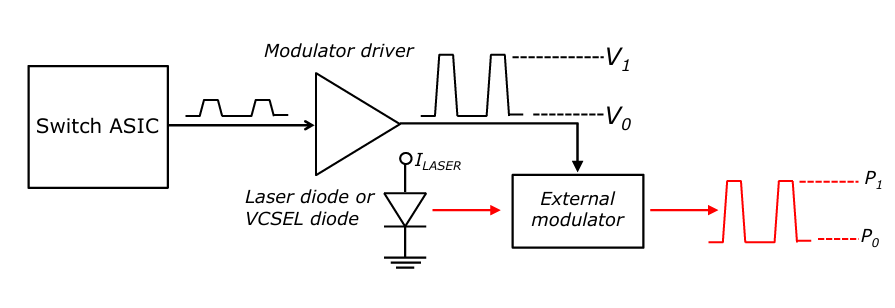
At a high level, the job of a transmitter is to transmit the data at the specified data rate (224GPBS) with as low BER as possible in the given specification. Key system level performance specs include:
Power efficiency: The ratio of energy consumed to the amount of data transmitted. This is usually measured in pJ/bit.
BER: Bit error rate. Noise, loss and other effects degrade bit error rate. Requirements range between 1e-4 and 1e-6 depending on the standard.
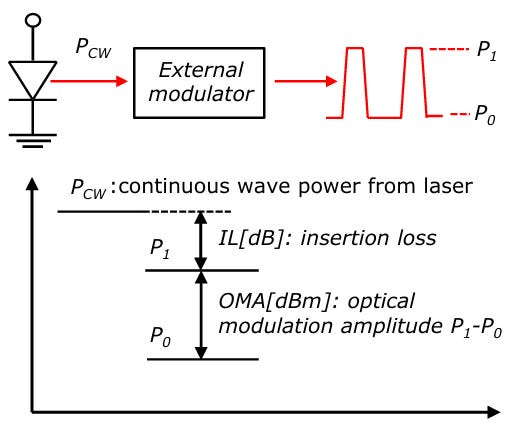
A laser source (whether that be generated on board or coupled in externally) provides the power and is sent through a lossy modulator, connectors, and waveguides.
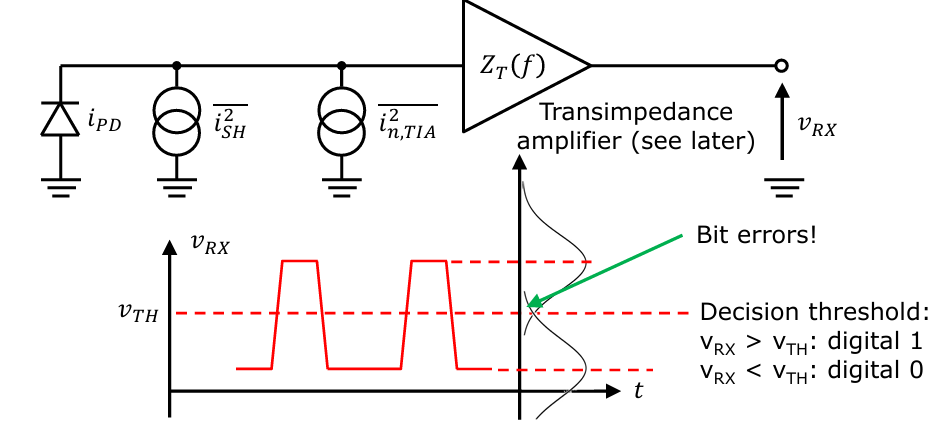
This power is then sent through the optical channel, converted back to a weak electrical signal through a photodetector, and amplified by a transimpedance amplifier. The signal at the RX need to be high enough compared to the noise in order to be able to detect the signal properly.
All of the sources of loss in between the TX and RX must be quantified for in a link budget in the optical chain. Lets break down each part.
Lasers
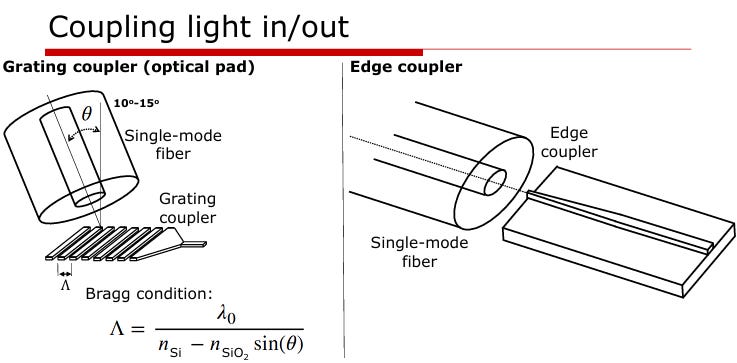
Lasers are either integrated within the PIC or coupled in externally. These external lasers are coupled into the chip through edge couplers or grating couplers.
There are a few important specifications:
Power: The amount of coupled power is limited by two-photon absorption and other non ideal effects. Shown is a sweep of Pin vs Pout where Pout saturates and a high enough Pin can cause passivation melting:
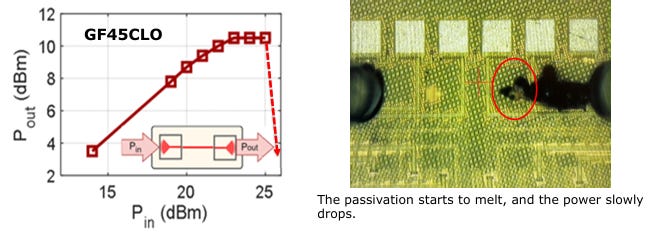
Figure 6. The Pout/Pin characteristics to couplers where the power saturations after a certain point. Source: Aflatouni, F. “Silicon photonics-based solutions: components, circuits, and integration” ISSCC 2026 Relative intensity noise (RIN) - Rin refers to the relative intensity fluctuations of the optical signal of a laser source. This is a critically important parameter in PAM4 schemes because PAM4 has much lower noise margin than NRZ. A high RIN raises the noise floor causing a higher BER. RIN is given by:

Companies with lasers in the value chain include Lumentum, Broadcom, Coherent, Sivers, Scintil, Xscape, and Quintessent.
Losses in Connectors
There are several loss sources in the connectors themselves. These include:
Modulator loss - due to intrinsic optical absorption and scattering
Multipath Interference (MPI) - Optical reflections from multiple connectors / discontinuities
Polarization Dependent Loss (PDL) - Measures loss due to change in signal polarization
Receiver
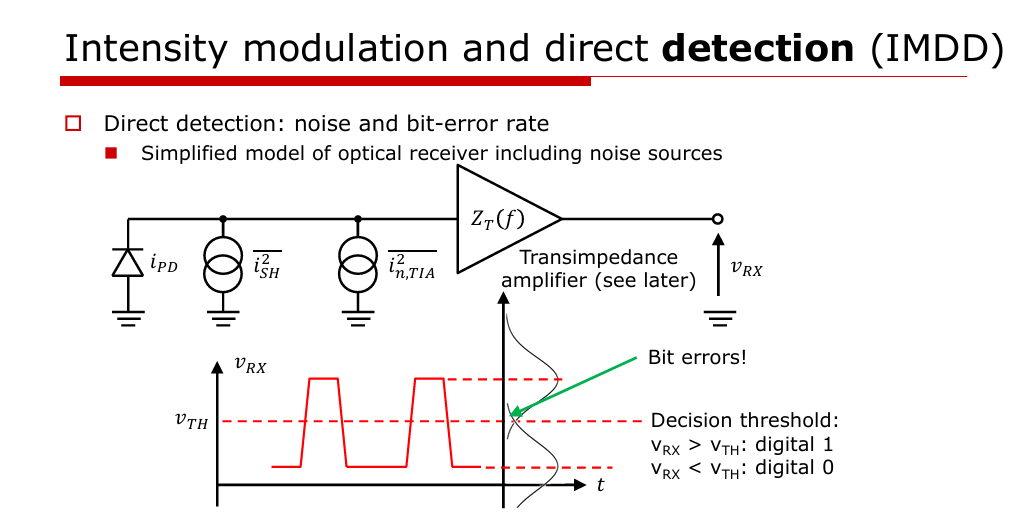
On the receive side, the signal is detected by a photodetector. This weak signal plus a noise signal is converted to a voltage through a transimpedance amplifier (TIA) that converts current to voltage.
A few key specs here are important:
Responsivity - Measures how effective the photodetector converts photons to electrons. This is typically measured in A/W.
Dark current - Measures the current flow when no light is present. Defects can cause high dark current that adds noise to RX and reduces sensitivity.
Input-referred noise - assesses the noise floor of the TIA.
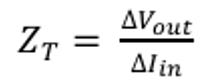
Transimpedance Gain - measures the electrical strength of the receiver. TIA gain is very important because if TIA gain is too low, output voltage swing will not be high enough to compensate for noise. It is given by:
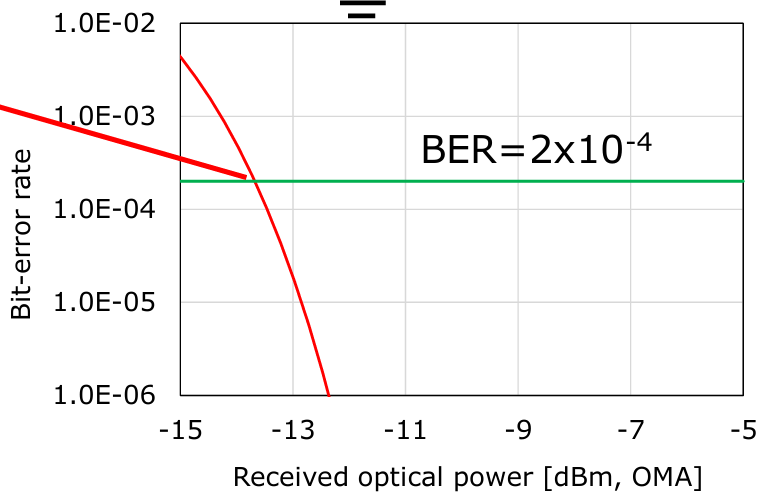
Receiver sensitivity - the minimum optical power required to achieve a specific BER target. This is determined by plotting RX BER vs OMA. BER goes down when received optical power goes up.
THD (Total Harmonic Distortion) - quantifies the non-linearity of the TIA. This affects PAM4 because it affects how even spaced out each of the four levels are after optical to electrical conversion.
Eye Quality
After the paywall I’ll go into key parameters that define the eye quality, practical challenges when scaling production of SiPh, and NVIDIA’s approach to thermal tuning design.
If you’re curious to learn more, check out my other posts here:


