
How to Overcome the Induced Numbness Problem in Business
A case study of how L. David Marquet turned the worst performing Navy submarine around with curiosity and pushing authority down

Most engineering orgs say they value ownership and innovation—but their systems often reward the opposite: compliance, hesitation, and dependency.
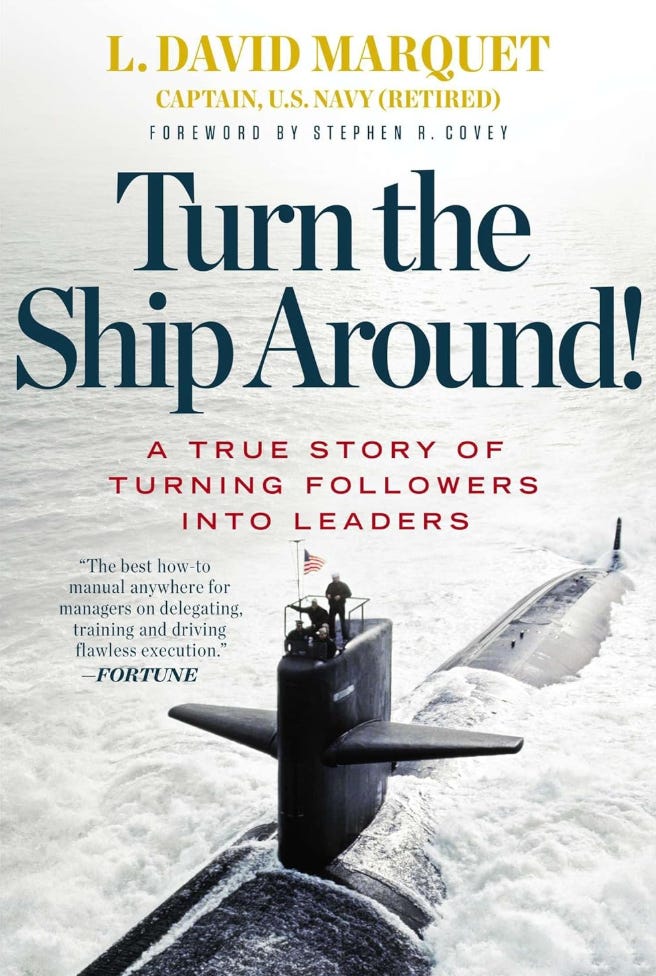
I was deeply inspired by L. David Marquet’s Turn the Ship Around! A True Story of Turning Followers Into Leaders. Marquet took command of the USS Santa Fe—then considered one of the Navy’s worst-performing submarines by many measures—and proved that the usual “top-down, give orders” model wasn’t the only way to lead. Instead, he pushed decision-making downward and built a system where the people closest to the work had real control and accountability. The result was a dramatic turnaround in performance, retention, and overall operational excellence.
L. David Marquet’s core insight is simple (and uncomfortable): when leaders make all the decisions, they may get control—but they also train everyone else to stop thinking, and causes talent to atrophy and harder to “build bench strength from within”.
What top-down leadership is (and why it’s so seductive)
In a top-down model, major decisions are made by a leader/manager, then handed down for execution. It can look efficient—especially under time pressure—because:
one person holds the “map”
clarity feels high
accountability appears concentrated
leaders get rewarded for being decisive
The trap is that over time, followers outsource judgment to authority. And the org quietly becomes less adaptive.
When top-down goes too far: the “induced numbness” problem
When people learn that “the safest move is to wait,” you start seeing predictable behaviors:
Process becomes the objective. Doing the steps matters more than achieving the outcome.
“Perfect on first presentation.” People optimize for not getting criticized instead of iterating openly.
Waiting for permission. Teams delay decisions that could be made locally.
Ownership collapses at the interfaces. Critical blocks become “someone else’s problem.”
Silo friction + blame games. Cross-functional groups protect themselves instead of solving together.
This is how you end up with organizations that look busy but move slowly—and require “heroes” to ship.
The core idea from Marquet: push authority down without losing control
Marquet didn’t remove leadership. He changed what leadership does.
1) Replace “permission” with intent Instead of “Can I…?” people say: “I intend to…”
That forces real thinking: the plan, assumptions, tradeoffs, and risks—while still giving the leader a chance to course-correct.
2) Build psychological safety through early, frequent thinking out loud
Frequent 1:1s, short feedback loops, and candid early discussions reduce rework and prevent silent divergence of assumptions.
3) Cut process that doesn’t serve the objective
Too much process numbs initiative and thinking. Too little creates tribal knowledge and chaos. The goal isn’t “less process.” It’s right-sized process that amplifies judgment.
What happens when you do this well
Marquet’s results were dramatic: retention, promotions, performance, and a ship that could operate at a high level even when the captain wasn’t the single point of decision-making.
In corporate terms: you’re building a leadership pipeline and reducing dependence on individual heroes and can build talent from with.
Why organizations struggle to change
These barriers map cleanly onto tech orgs:
Mindset inertia. Leaders and followers are trained into the old model. Under stress, everyone reverts.
The seductive pull of control. Many leaders who’ve “played the game” don’t want to easily give up power to followers
Short-term incentives. Shipping this quarter is rewarded more than building systems that outlast you.
Skill atrophy. People who’ve been “numbed out” need time + coaching to rebuild judgment muscles.
It’s not painful enough yet. Change often arrives only after churn, misses, or quality crises.
I think every engineering team can take something from this book—even if your context isn’t a submarine.
What have you seen in your org: top-down control that helped… or top-down control that quietly reduced ownership? Curious where people agree / disagree.
References
Marquet, L. D. (2013). Turn the ship around!: A true story of turning followers into leaders. Portfolio.