
Learning Analog / Mixed Signal Design the Efficient Way
My secrets to self teaching complex subjects and explaining them as simply as possible

Most frustration in learning hard things comes from starting at the wrong zoom level.
I tried learning complicated things in analog design too early, like folded-cascode OTAs and PLLs in undergrad. I would get stuck fast — not because I wasn’t capable, but because I was being pulled into details before I had a mental frame to hang them on.
The turning point for me was realizing:
Complex topics don’t become easier when you memorize more details or view more lecture videos.
They become easier when you build better foundations and organize the details logically.
Here are the four moves I use to understand complex fields:
Pick one foundation source (one teacher)
Bottom-up summary (principle of operation)
Top-down map (hierarchical outline of concepts)
Relate advanced concepts from simpler ones (Folded Cascode OTA)
I’m going to use a few real analog design technical examples to make the method visible (because analog can get wonderfully complex).

Choose your foundation learning sources carefully
When learning a complex field, start with one “foundation source” that’s known for clarity, then translate it into your own mental model.
In analog design, that might be Razavis book and lecture videos.
In machine learning, that might be Andrew Ng’s Coursera courses.
The specific source matters less than the principle: pick one clear teacher, build your base, and then other authors start becoming more clear because you finally share the same “background assumptions.”
Once you’ve identified your foundation sources, the next step is straightforward: work through the material — read the chapters or take the course.
Bottom up Summary (Principle of Operation)
Read dense sections slowly and translate the author’s explanation into a “principle of operation” summary in your own words.
Example: Understanding Switching Behavior of a single transistor in Power Electronics
This method matters especially in power electronics, because switching waveforms can look intimidating at first glance.
A switching cycle has a lot happening in a short time:
different devices turning on/off,
different current paths,
different energy transfers
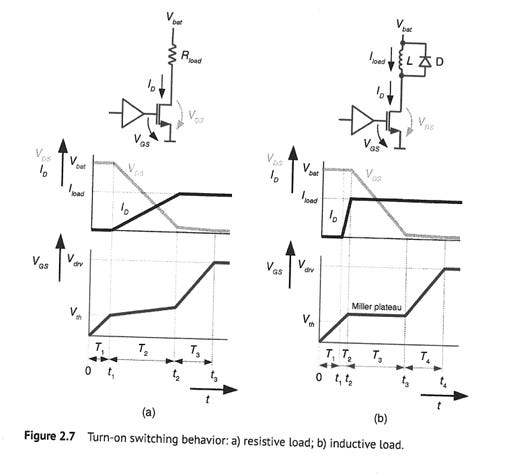
all across multiple time intervals. If you try to absorb the full diagram in one gulp, it becomes confusing. Take the following switching diagram for a gate driver driving a single transistor:
So here’s what I do:
I read the author’s explanation of how the circuit works. Typically this is very dense and has a lot of equations for rigor.
As I’m reading, I break down the switching diagram into three intervals.
In each time interval I’m writing a one line summary of what each voltage / current is doing.
T1: the “precharge phase” :
V_gs increases to V_th
T2: the “miller phase”:
V_gs increases slowly as V_ds transitions from V_bat to 0
T3: end of “miller phase” :
I_load reaches its peak
V_gs continues charging up to its peak value
I bold important concepts to make them easier on the eye to reference later (like the “Miller plateau”.)
Here are my personal notes where I write the principle of operation in my own words as I went through this section the first time:
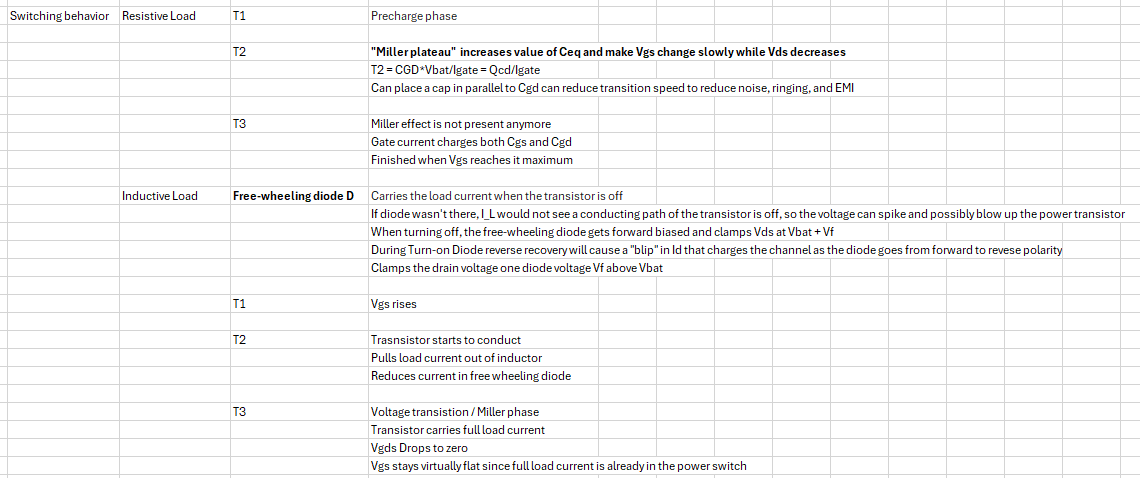
You might not explain the principle of operation the same way as me, but the point is that:
You summarize the material in a way you understand.
I have a post on the fundamentals of buck converters where I used this method to break down the principle of operations:

Top down - Hierarchical Breakdown of Concepts
I break down concepts broken down in a bullet format from high level concepts to low level ones that helps quickly “cue” the concept and retrieve the information I summarized earlier. This can apply to both architecture level and complex analog blocks


Here I will illustrate this with an ADC.
Example: ADC Architectures and Tradeoffs
I started reading the basics of ADCs on “Analog Integrated Circuit Design” and create a top level hierarchy of “textbook” topologies for various applications:
ADCs
Low - medium speed, high accuracy
Integrating
Oversampling / ΔΣ
Medium speed, medium accuracy
SAR
Algorithmic
High speed, low to medium accuracy
Flash
Two step
Interpolating
Folding
Pipelined
Time-interleaved
One popular ADC is the SAR ADC. Check out the important design considerations in this post:

Under each of these topologies, I expand into more detailed sub-architectures, including:
The architecture block diagram
The textbook transistor level implementation
The important specs / design parameters
The pros and the cons of the architecture compared to others
For example, here is my summary of the more general ADC “performance limits” section:
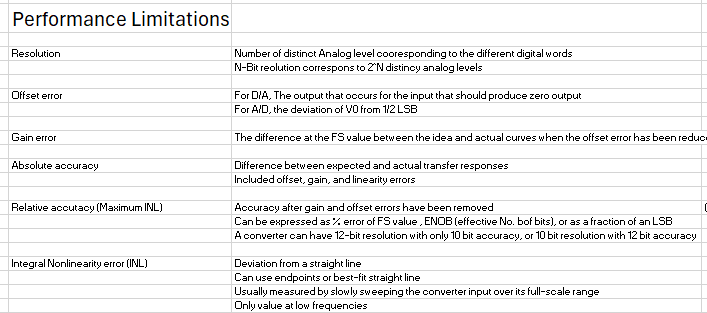
And here is an example of a section where I break down SAR ADCs, a very popular topology with a lot of research conducted on improving performance:
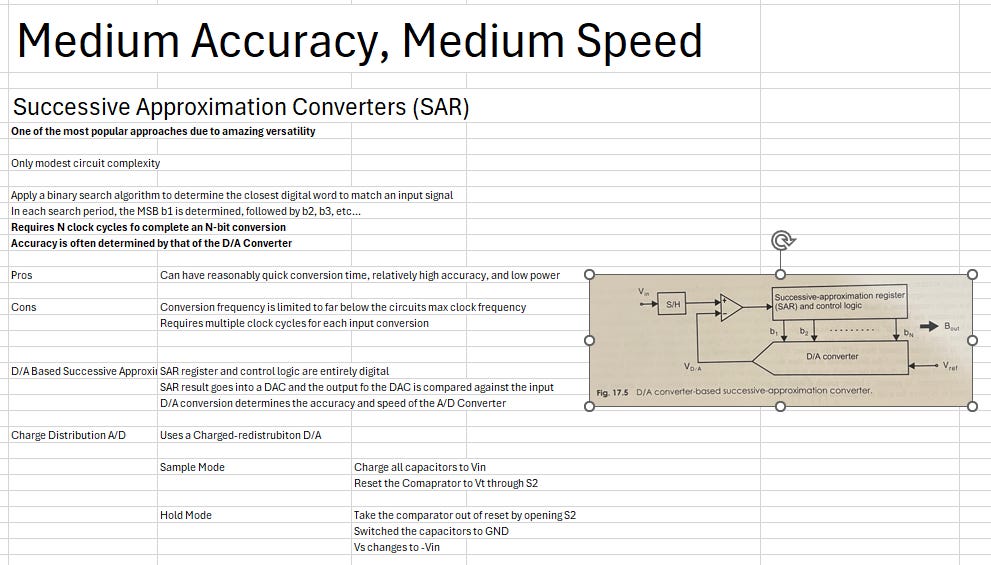
Once I have the map for a particular book, I started noticing gaps where I want more clarity on. I identify more specialized books in the area I am interested in and skim the table of contents to see if there is anything interesting. For example, I skim the table of contents for “Analog to Digital Conversion” by Pelgrom and make my notes on the chapter contents.
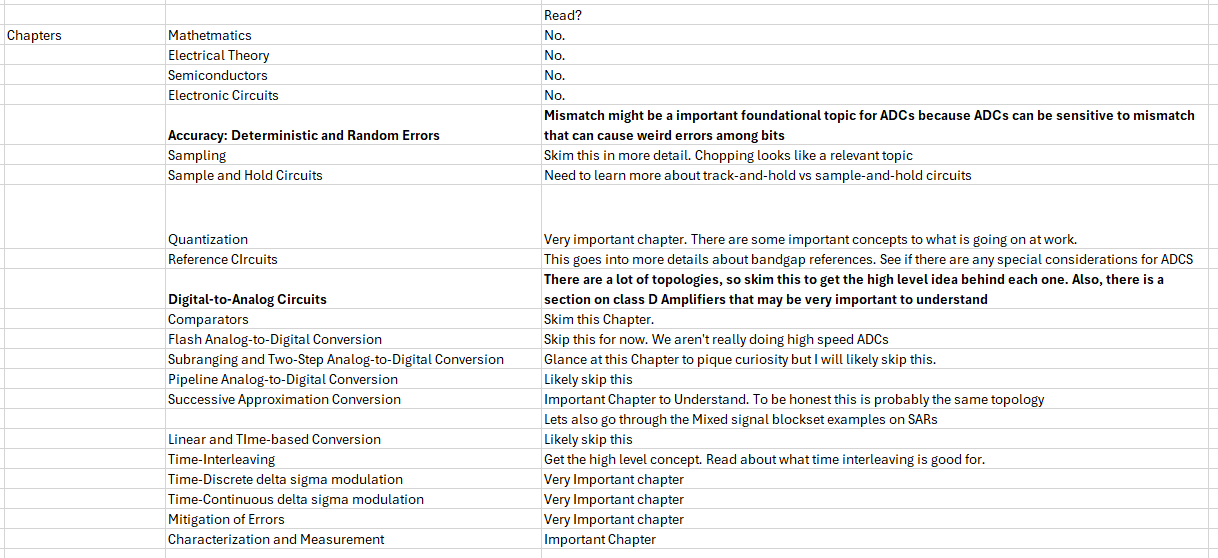
Then, once I identify a few specialized books, I purchase / borrow them and repeat the above process until I feel satisfied with the level of depth for the subtopics I am interested in.
This mental framework serves several benefits:
You become adaptable. If your project changes or a new architecture shows up, you already have a mental frame to reference to understand new things
You don’t waste time. You focus on the concepts that most improve your overall understanding.
You can understand what people are doing in research and other fields, because you have a useful “starting point” to ask insightful questions
In short, what you don’t read is just as important as what you read.
Here are two posts that dive into more depth on ADCs as well as a high speed SerDes architecture breakdown that requires tradeoffs against different topologies to be weighed:
Arrange simpler building blocks to understand more complex ones
Once you get enough of a knowledge scaffolding for simpler concepts, its time to arrange simpler concepts into understanding harder, more “state of the art” ones.
Example: Understanding a folded-cascode OTA
Folded-cascode OTAs are very common building blocks used in a lot of systems due to their high speed, gain and bandwidth, but they are not easy to learn at first. Here is a “textbook” implementation of one:
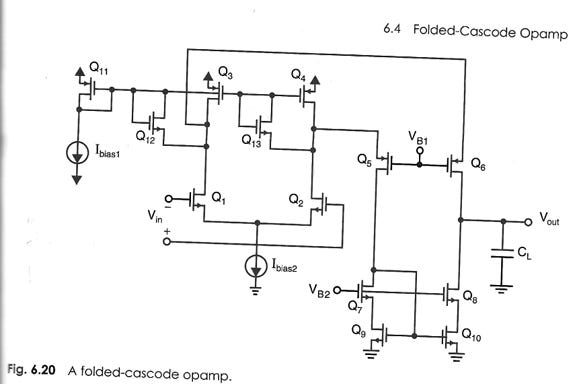
Trying to understand this without prior understanding of building blocks is difficult. If you’ve taken a basic electronics course in undergrad, you can sort of make out what each transistor is doing, but there’s a lot of complexity here.
Fortunately, we can break down the “building blocks” that comprise a folding cascode into simpler blocks and combine them. These building blocks include:
A conventional two stage op amp
The wide swing current mirror
The conventional cascode amplifier and the “folded” variant
Here are the block diagrams for each:
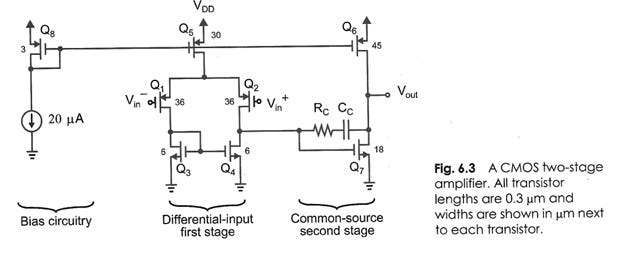
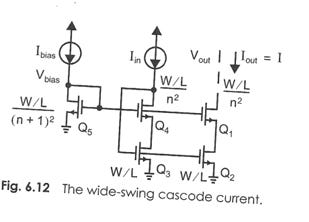
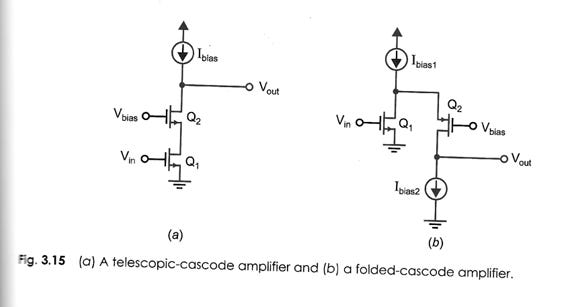
I do a principle of operation summary for each of these blocks with the above procedure, which I will not show here.
Then I do a principle of operation summary for the folded cascode OTA:
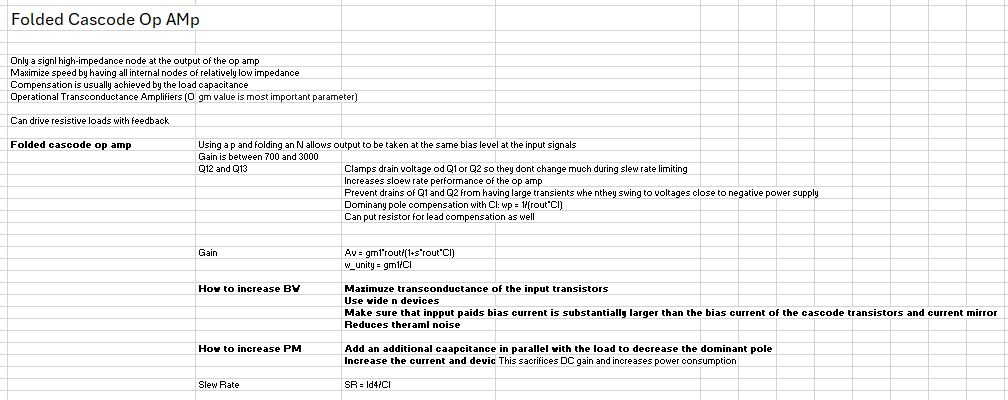
Now I am able to understand concepts like “low impedance nodes” as well as how to improve Bandwidth / Phase Margin because I understand the concepts from the simpler two stage op amp example.
In short, by understanding concepts for simpler blocks first, I am more likely to understand the principle of operation for more complicated, state of the art blocks because I have pre-existing context into what the simpler blocks are doing.
Summary
My rule of thumb is simple:
If you don’t understand the simpler topology, don’t jump straight to the state-of-the-art one.
Work backward. Identify what’s confusing, find the prerequisite concept, and rebuild from there.
A lot of people give up when something feels overwhelming — which is a shame, because most “advanced” ideas become very learnable once you’ve climbed the ladder in the right order.
These are just methods that work well for me. I’m sure others have great approaches too — and I’d love to learn them.
If you’ve found a learning strategy that helps you understand hard technical subjects, drop it in the comments.
I also have several other posts if you want to continue learning about the design process of analog design and a few key blocks and systems:
References:
[1] “Circuit Diagram” (xkcd #730) by Randall Munroe — xkcd.com. Source: https://xkcd.com/730/ License: CC BY-NC 2.5 — https://creativecommons.org/licenses/by-nc/2.5/ Changes: Cropped/resized for header.
[2] T. C. Carusone, D. A. Johns, and K. W. Martin, Analog Integrated Circuit Design. John Wiley & Sons, 2011.
[3] B. Wicht, Design of Power Management Integrated Circuits. John Wiley & Sons (IEEE Press), 2024.
[4] M. J. M. Pelgrom, Analog-to-Digital Conversion, 2nd ed. Springer, 2013. (DOI: 10.1007/978-1-4614-1371-4)