
Designing the Interface: Where Modularity Wins—and Where It Breaks
Be modular where you can, but tightly integrate as needed for optimal performance

“Design Reuse!”
“Faster Time-to-Market!”
“Streamlined Integration!”
‘Well-defined Interfaces!”
“Operational Efficiency!”
Everyone loves the benefits that modularity promises. Design reuse. Well characterized interfaces. Upgrading individual subsystems.
And everyone also loves improved performance: those rare products and components where people will happily wait in line and pay a premium.
But you can’t have everything. Here’s the catch:
Modularity and peak performance often pull in opposite directions.
Modularity buys speed, flexibility, and portability by freezing interfaces.
But every ounce of generality adds an “Interface tax”:
Interface tax = the extra power/area/latency/complexity you pay because the interface must support more use-cases than your use-case.
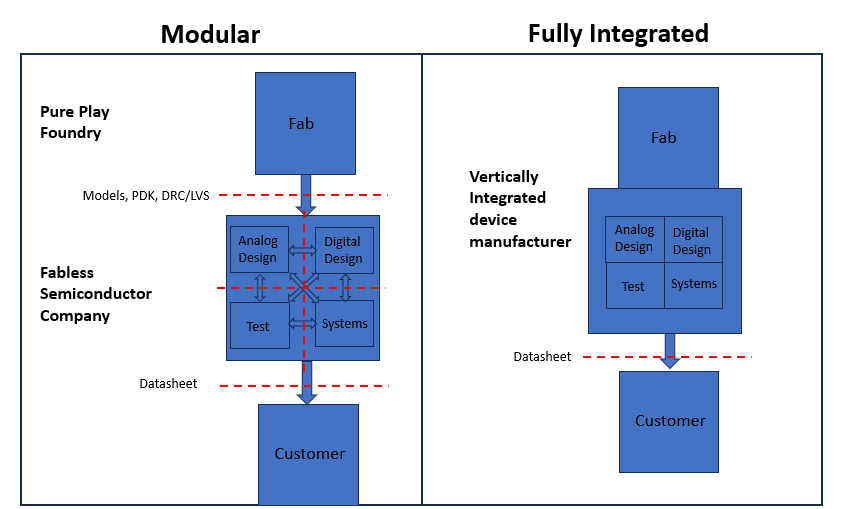
This idea of “modular” vs “interdependent” came from the book “Innovators Solution” by Clayton Christiansen. He uses it to mostly describe marketing of products with performance specs that the market demands, but I will adapt the terms to describe how systems are built up.
Modular Components are everywhere in semiconductors
A modular component is anything with an interface that’s stable and sufficiently complete for other teams to use without knowing the internal workings of it.
You see modularity at every layer:
Fab: PDK + rules
Chip: cells/IP/macros
System/software: protocols + APIs
In other words: modularity isn’t a hardware thing or a software thing.
It’s an interface thing.
Modularity simplifies to make engineering scalable
Modularity offers real, day to day benefits in simplicity:
Reuse across multiple designs
Upgradability: Components can be swapped / upgraded independently as long as they obey the interface
Coordination: Teams work at arm’s length and align through requirements + handoffs
This is how you make large organizations move faster without everyone needing to understand everything.
Modularity forces you to define flexibility up front
Modularity forces a hard question up front:
How flexible should this interface be?
Flexibility is a spectrum:
Hard IP: narrow interface → low overhead → low flexibility
Flexible IP: wider interface → more future-proofing → higher overhead
And it’s not purely technical—it’s business-driven. You’re forecasting what future products and spec ranges you think you’ll need.
Concrete example: FPGA vs ASIC (flexibility vs efficiency)
FPGAs: maximum flexibility and fast iteration (program with RTL), but you pay the tax in power, area, and clock speed.
ASICs: remove generality and target a specific application—higher performance, but much longer to build and far less optionality once built.
Where modularity “breaks”: the interface tax shows up
Modularity isn’t “bad.” It’s just not free. The tax tends to appear in three places:
Performance Tax
Standardization simplifies integration—but it often prevents true end-to-end optimization.
Complexity Tax
Modularity shifts expertise from “custom design” to owning and maintaining the interface.
That’s why orgs create IP / I/O / library / platform teams: to standardize blocks other teams use, own the interface, manage versions, and handle edge cases as reality expands beyond the original spec.
Coordination Tax:
Documentation matters everywhere, but modular interfaces raise the bar:
datasheets/specs that match reality
simulations/tests performed “behind the interface” that prove behavior
versioning, change control, and clear ownership
Bottom line: modularity buys speed and flexibility—but the interface tax shows up in sub-optimal performance, increased complexity, and increased coordination.
Where Interdependent Architectures shine: Maximizing Performance
Interdependent architectures shine when performance is “not good enough”—meaning customers will pay a premium to remove the bottleneck.
Performance comes from co-optimizing across layers of the stack. Tight integration lets engineers fit pieces together more efficiently than any off-the-shelf assembly can:
better performance-per-watt
lower latency
smaller footprint
Depending on what’s limiting, companies either build key blocks in-house (custom ASICs) or tightly coordinate with best-in-class partners where it matters most.
Example: interdependence across the stack
Interdependence shows up everywhere in highly sophisticated products (such as mobile, PCs):
Fab
Custom process steps and tight integration of lithography/ patterning/etch/deposition choices
On-Chip:
AMS/RFIC: parasitics, impedance, coupling—everything interacts, everything matters
Verification of Timing/power/analog interactions amongst sub-blocks
Test / Validation
Custom application boards and setups tuned to a specific product’s edge cases
System
Co-design of thermal, signal integrity, power delivery, package, and firmware
Software
Application-specific firmware + drivers + systems software tuned around the hardware behavior
As architectures become more interdependent, companies share less because the advantage lives in the co-optimization details, and know-how becomes the bottleneck.
Conclusion: complex systems contain both
Modularizing is smart at every level—it prevents unnecessary redesign, creates stable handoffs, and enables reuse.
But modularity isn’t the end-all, be-all—because it rarely squeezes maximum performance out of a product.
In short,
Be modular where you can, interdependent where you must.
In the future I’ll build on these concepts in future posts. Stay tuned.
References
Christensen, Clayton M., and Michael E. Raynor. The Innovator’s Solution: Creating and Sustaining Successful Growth. Boston, MA: Harvard Business School Press, 2003.