
An Overview of Semiconductor Marketing: From Small Scale Innovation to Economies-of-Scale
Five gold standard books that capture a wholistic view of the semiconductor industry

The semiconductor industry is arguably the world’s most sophisticated industry. While Moore’s Law has enabled chips to scale in performance-per-area, the marketing and strategy behind the silicon are unique due to the massive economies of scale involved.
To lead in this space, semiconductor marketers must possess a rare combination of skills: an understand of what key performance metrics customers are willing to pay a premium for, the ability to translate complex capabilities into business value, a time-to-market instinct, and a holistic grasp of the supply chain involved.
To understand why the industry is shaped the way it is, I have mapped out five foundational books and three key themes from each. Together, they form a cohesive foundation for understanding the move from disruptive innovation to the brutal realities of global economies-of-scale.
This post is designed for readers who want to gain a feel for to “why” the semi value chain is the way it is due to the complex interdependencies. I’ll keep a high level discussion here; refer to the books for more detail.
Innovators Dilemma
Innovation is a trap. Christensen’s core thesis is that “great” companies fail not because they are poorly managed, but because they are too responsive to their most profitable customers. He hits upon three key themes:
Sustaining vs. Disruptive Innovation: Large incumbents excel at sustaining innovation—incremental improvements for high-margin tiers. However, they often ignore disruptive innovation—low-end, lower-performing tech that eventually scales to intersect and destroy the incumbent’s market.
The Resource Allocation Trap: In semiconductors, where gross margins of 50%+ are the gold standard, executives are incentivized to “eat their way up” the value chain. This leaves the “bottom” of the market open for new entrants who can scale faster than the incumbents can pivot.
The “Right Stuff” Bias: Organizations often use “heuristic shortcuts” for hiring and promotion, favoring managers who maximize short-term ROI. However, these are often the wrong people to lead a disruptive unit that needs to focus on learning rather than just execution.
Crossing the Chasm
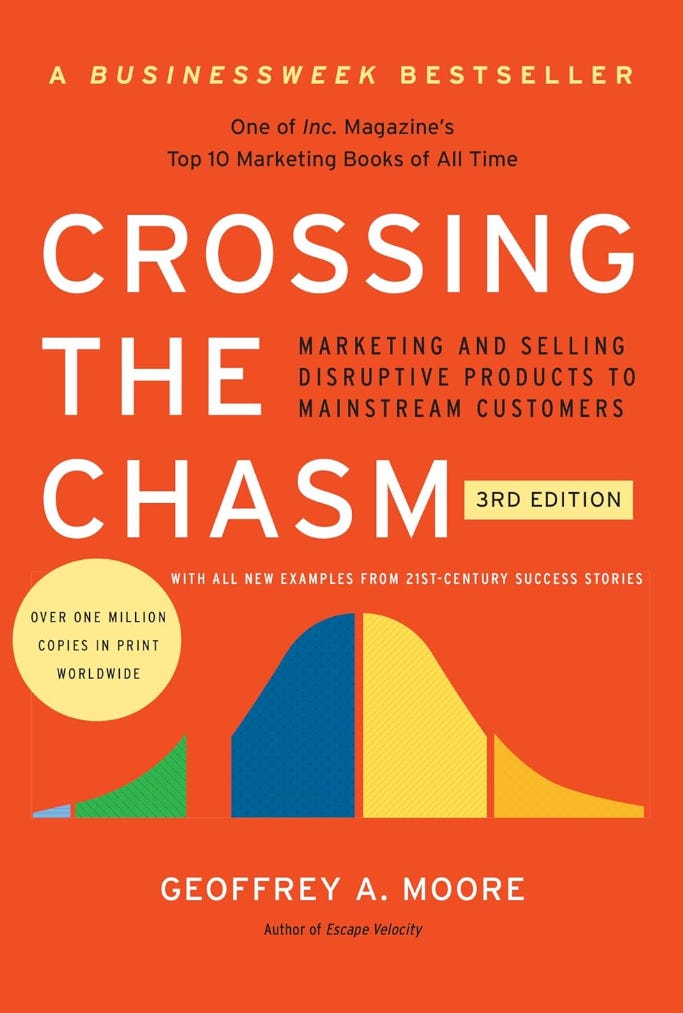
If Christensen explains why firms fail to innovate, Geoffrey Moore explains why innovations fail to sell. The “Chasm” is the massive psychological gap between Early Adopters (who see the performance benefits) and the Early Majority (who want to follow the market leader). For products to cross this chasm, Moore proposes three key marketing strategies:

The Beachhead Strategy: In a mainstream market, the early majority delays buying until they see a clear leader. To win, market share, companies must secure a “beachhead”—a specific, referenceable pragmatist customer base that allows them to “own” a niche before expanding.
The Whole Product Concept: Marketing in semis often fails when engineers tout specs (FLOPs/TOPs) instead of solutions. Pragmatist customers buy the “whole product”—the silicon, the software stack, the documentation, and the support.
Positioning as a Heuristic: Positioning isn’t about what the product is; it’s about creating a mental shortcut for the buyer that differentiates your product relative to the competition.
Example: NVIDIA’s early success wasn’t just about GPU architecture; it was about positioning themselves as the “only way” to play Doom or run professional CAD, creating a marketplace where they were the only reasonable choice.
Fabless: The Transformation of the Semiconductor Industry
This book tracks the “raw” history of how the industry moved from Integrated Device Manufacturers (IDMs) to the specialized, horizontal ecosystem we see today.
The EDA & IP Revolution: The rise of Electronic Design Automation (Cadence, Synopsys) and reusable IP (ARM) decoupled design from manufacturing. This allowed “Fabless” companies to focus on architecture while outsourcing the capital-intensive fabrication.
The Rise of “Coopetition”: As technology advances, no single company can do it all. We see increasing interdependencies: Samsung is Apple’s fiercest rival in handsets but its most critical partner in the foundry/supply chain.
The System-in-a-Package (SiP) Era: We are moving past the “single chip” era. Modern high-end silicon (like FinFET-class chips with 3D memory stacks) requires a massive ecosystem of specialist companies to collaborate just to get a single product to market.
Chip War: The Fight for the world most critical technology
Strategy does not happen in a vacuum. Miller maps the industry through the lens of “Geopolitical Chokepoints”—specific nodes in the supply chain where a single entity holds disproportionate power.
Mapping the Nodes: The supply chain is concentrated in specific geographies: EUV lithography in the Netherlands (ASML), manufacturing in Taiwan (TSMC), and EDA tools in the U.S.
The Silicon Shield: Taiwan’s dominance in high-end manufacturing creates a “shield” where the global economy is too dependent on their output to allow for instability.
Sovereign Silicon: We are seeing a shift where “marketing” a semiconductor company now involves navigating national security interests, as countries race to reverse-engineer, replicate, or replace foreign technology.
Apple in China: The Capture of the Worlds Greatest Company
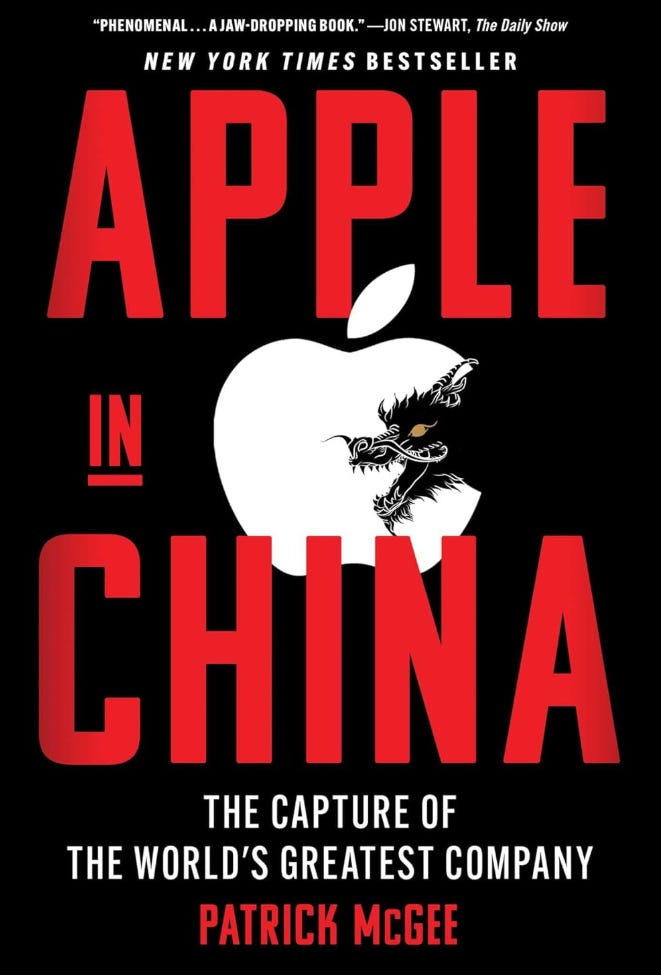
Apple is the ultimate case study of all the previous concepts clashing in real-time. It is a masterclass in managing the “value network” across geopolitical lines while fighting the “innovator’s dilemma.”
Zero-Defect Mentality: Apple’s success is built on a “zero-defect” mindset and a brutal Custom Silicon Management (CSM) process. They train suppliers to scale quality, then “pit” rivals against each other to drive down margins.
The China Challenge: Apple highlights the tension of being a Western company deeply integrated into the Chinese ecosystem. While they benefit from the scale of partners like Foxconn, they face “reverse-engineering” threats from local giants like Huawei.
Serialization as Control: To maintain their brand and deter bad actors, Apple serializes almost every component. This is a marketing and supply chain tactic to “own” the customer experience—even if it creates friction with right-to-repair advocates.
Conclusion
Understanding the semiconductor market isn’t just about knowing the “what” (the specs); it’s about knowing the “why” and how all the elements (marketing, geopolitics and technology) are interconnected. We see a map of an industry that is simultaneously the most globalized and yet the most protective on earth.